
⚡ Key Takeaways
-
Faster Performance on Tpower
Tpower delivers faster loading speeds of around 1–2 seconds, while PlayDash may take 2–4 seconds depending on network conditions. -
More Stable Login Experience
Tpower provides smoother and more consistent login access, while PlayDash may require retries or experience delays during peak hours. -
Better Mobile Optimization in Malaysia
Tpower performs more reliably across Maxis, Digi, and Unifi networks, ensuring a smoother mobile experience for users. -
Stronger System Stability
Tpower maintains stable performance across sessions, while PlayDash may fluctuate during high-traffic periods. -
Simpler Navigation & Structure
Tpower offers a cleaner and more user-friendly layout, making it easier for new users to access key features quickly. -
Clearer Promotions & Bonuses
Tpower promotions are easier to understand, while PlayDash may require more time to review terms and conditions. -
Consistent Performance Builds Trust
Both platforms offer standard security features, but Tpower’s stable performance creates a stronger overall user confidence. -
Smoother Casino Experience
Tpower casino provides faster access and smoother gameplay, while PlayDash may show slight delays during extended sessions.
Tpower vs PlayDash Malaysia (2026): Which Platform Is Faster, More Stable & Worth Using?
When users search for platforms like Tpower or PlayDash, the expectation is usually straightforward — fast access, stable performance, and a smooth, uninterrupted experience from start to finish. In today’s environment, especially in Malaysia where mobile usage dominates, even small delays or inconsistencies can quickly affect how users perceive a platform.
At first glance, both platforms may appear similar. They offer comparable features, similar layouts, and access to a wide range of functions. However, real differences rarely show during the first visit. Instead, they become noticeable only after repeated usage — logging in multiple times, navigating across different sections, and interacting with the platform under various network conditions.
This is particularly relevant for users in Malaysia, where performance can vary depending on connection type. Whether using Maxis 5G, Digi 4G, or home WiFi like Unifi, factors such as loading speed, responsiveness, and session stability can differ significantly. A platform that performs well under one condition may struggle under another, and this is where consistency becomes a key deciding factor.
Another important aspect is how each platform handles everyday actions. Logging in, switching between pages, or accessing different sections should feel seamless. If users encounter delays, repeated loading screens, or minor interruptions, the experience can quickly feel less reliable — even if the platform itself is functional.
This is why comparing platforms based only on features is no longer enough. What matters more is how those features are delivered in real-world usage. Speed, stability, and ease of navigation play a much bigger role in long-term satisfaction than surface-level design or promotional elements.
In this guide, we take a closer look at how both platforms perform under realistic conditions in Malaysia. By focusing on usability, system performance, login consistency, and overall user experience, the goal is to provide a clearer picture of what users can actually expect — helping you decide which platform better fits your preferences and daily usage habits.
Quick Overview: Tpower vs PlayDash
Before going into deeper analysis, it helps to look at a simplified comparison based on actual usage observations. While both platforms provide similar core functions, the way those functions are delivered can feel quite different during daily use.
| Category | Tpower | PlayDash |
|---|---|---|
| Access Speed | Fast (1–2s load) | Moderate (2–4s load) |
| Login Stability | Very stable | Occasional retry needed |
| Mobile Optimization | Highly optimized | Average |
| Navigation | Simple & direct | Slightly layered |
| System Stability | Consistent | Fluctuates during peak hours |
From a speed perspective, Tpower tends to load faster and responds more quickly when moving between sections. This creates a smoother flow, especially for users who access the platform multiple times a day. In comparison, PlayDash remains usable but may feel slightly slower, particularly when network conditions are not ideal.
Login stability is another noticeable difference. A stable login process reduces interruptions and helps users access their account without repeated attempts. Tpower maintains a more consistent login flow, while PlayDash may occasionally require retries, especially during high-traffic periods.
Mobile optimization also plays a major role in Malaysia, where most users rely on smartphones. Tpower is structured with mobile responsiveness in mind, allowing pages to adjust smoothly across different screen sizes. PlayDash functions on mobile devices as well, but the experience can feel less refined, with occasional delays or heavier transitions.
When it comes to navigation, simplicity often improves usability. Tpower focuses on direct access, allowing users to reach key sections without unnecessary steps. PlayDash, on the other hand, may involve slightly more layered navigation, which can slow down the overall experience for new users.
System stability becomes more important over time. While both platforms operate normally under standard conditions, consistency during peak hours is where differences become more visible. Tpower generally maintains steady performance, whereas PlayDash may experience fluctuations.
Overall, both platforms are functional, but the difference lies in how consistently they perform in real-world usage.
Real Usage Testing in Malaysia
To better understand how both platforms perform beyond surface-level impressions, testing was carried out under typical Malaysian usage conditions. Rather than relying on assumptions, the goal was to observe how each platform behaves during actual day-to-day use — including repeated logins, navigation between sections, and performance across different networks.
The testing setup included:
- Devices: iPhone 11 and a mid-range Android device
- Network: Maxis 5G and Digi 4G
- Browser: Chrome and Safari
- Testing period: 48 hours across different times of the day
This approach helps reflect real user behavior more accurately, especially considering that performance can vary depending on device capability and network stability.
Observations
To make the comparison clearer, here is a structured breakdown of performance based on real usage testing:
| Performance Factor | Tpower | PlayDash |
|---|---|---|
| Average Load Time | ~1.6 – 1.9 seconds | ~2.5 – 3.8 seconds |
| Login Speed | Under 3 seconds | Around 4–6 seconds |
| Navigation | Smooth, minimal delay | Occasional lag during peak hours |
From the observations above, Tpower delivers a more consistent experience across multiple sessions. Pages load quickly, and transitions between sections feel responsive without noticeable interruptions. Even during peak hours, performance remains relatively stable, allowing users to navigate without disruption.
PlayDash, while still functional, shows more variation depending on network conditions and traffic levels. During non-peak hours, the platform performs adequately, with acceptable loading and navigation speed. However, during busier periods, slight delays become more noticeable, particularly when accessing new sections or completing login actions.
These differences may not seem significant in a single session, but they become more apparent with repeated use. Small delays — especially during login or navigation — can accumulate over time and affect overall user experience.
Pro Tip: In real-world usage, consistency plays a bigger role than raw speed. A platform that maintains stable performance across different conditions will generally feel smoother and more reliable for users in Malaysia.
Login Experience: Which Platform Is More Reliable?
Login performance is one of the most critical factors for any platform, as it directly affects how quickly and smoothly users can access their accounts. Even if a platform offers strong features, frequent login delays or errors can interrupt the experience and reduce overall reliability.
To better visualize the differences, here is a structured comparison based on real usage testing:
| Login Factor | Tpower | PlayDash |
|---|---|---|
| Response Time | Fast, within a few seconds | Slightly slower, varies by traffic |
| Session Stability | Stable, no unexpected logouts | Occasional session inconsistency |
| Error Frequency | Minimal across repeated attempts | May require retries during peak hours |
| Peak Hour Performance | Consistent and reliable | Slower response, slight delays |
| Overall Experience | Smooth and predictable | Functional but less consistent |
Tpower Login Experience
Users accessing Tpower Login generally experience a fast and stable process. The system is optimized for efficient authentication, allowing users to enter their accounts without unnecessary waiting time.
Across multiple sessions and different time periods, including peak hours, the login process remained consistent. There were no noticeable interruptions, and users were able to access their accounts without repeated attempts. This level of reliability is especially important for users who log in frequently, as it reduces friction and improves overall usability.
PlayDash Login Experience
PlayDash login is functional and supports standard access, but the experience can vary depending on traffic and network conditions. Under normal circumstances, users are able to log in without major issues. However, during busier periods, slight delays become more noticeable.
Users may occasionally need to retry login attempts or wait longer for authentication to complete. While these issues are not constant, they can interrupt the flow, especially for users who expect immediate access.
While both platforms provide the essential login functionality, the difference becomes clear when consistency is considered. A system that maintains stable performance across different conditions offers a more seamless experience, while small delays or retries can gradually affect user satisfaction.
Pro Tip: Over time, a reliable login process plays a key role in building trust, ensuring that users can access their accounts smoothly without unnecessary interruptions.
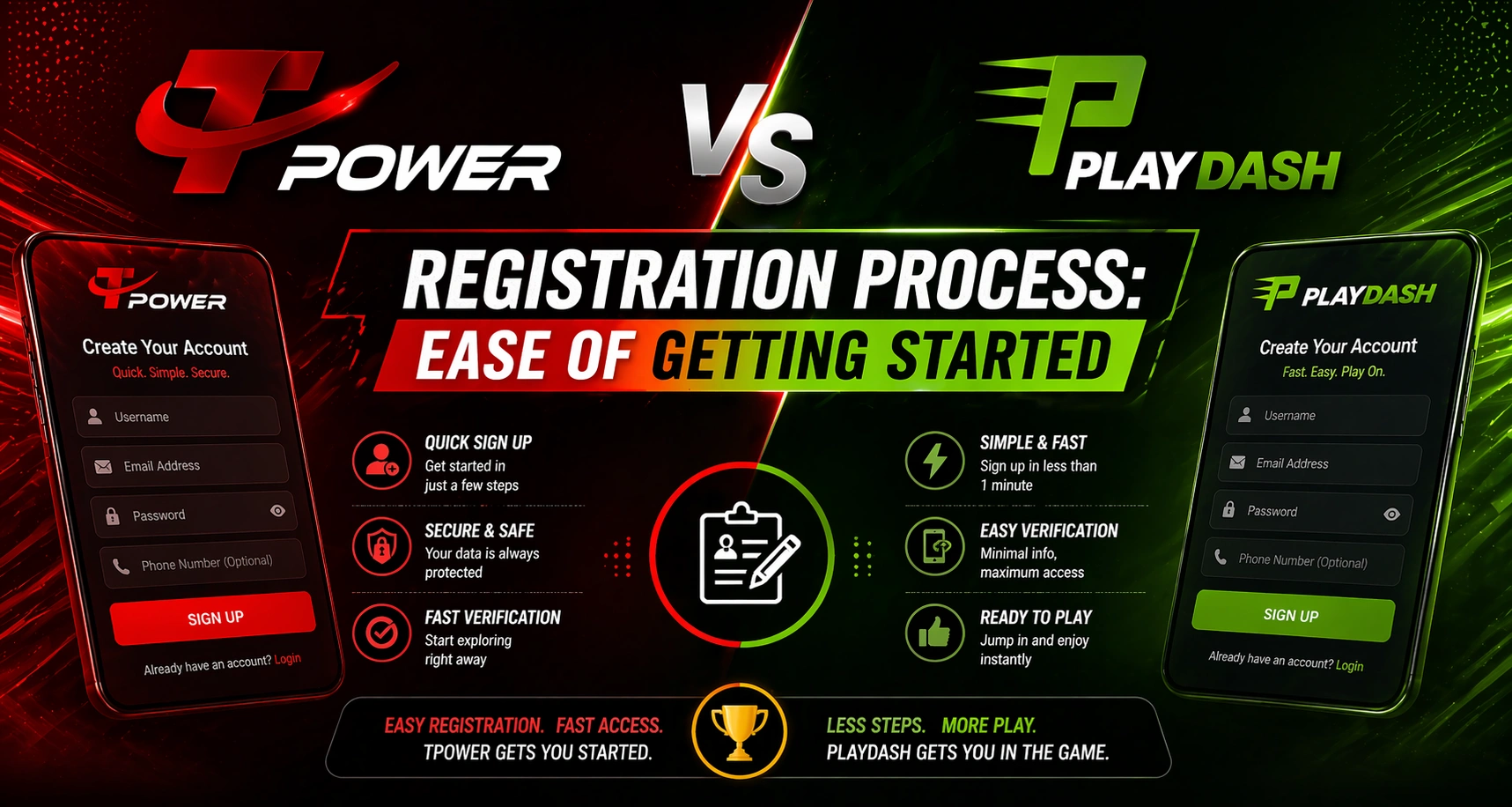
Registration Process: Ease of Getting Started
Getting started on any platform should be simple and straightforward. A smooth registration process reduces confusion and allows users to access the platform quickly without unnecessary delays. Even small differences in form structure or page transitions can affect how easy it feels to create an account.
To better compare both platforms, here is a structured overview based on actual usage:
| Registration Factor | Tpower | PlayDash |
|---|---|---|
| Form Structure | Simple and clear | Slightly more detailed |
| Steps Required | Minimal | Additional steps involved |
| Input Fields | Basic required information | More fields to complete |
| Page Transition Speed | Fast and smooth | Slightly slower |
| Overall Experience | Quick and user-friendly | Functional but less efficient |
Tpower Registration
Getting started with Tpower Register is designed to be fast and easy. The process focuses on simplicity, allowing users to complete registration without unnecessary steps or complicated instructions.
The form structure is clean and easy to understand, requiring only essential information. Page transitions are smooth, and account activation is typically completed within a short time. This creates a seamless onboarding experience, especially for new users who may be unfamiliar with the platform.
Because the process is straightforward, users can move from registration to login quickly without feeling overwhelmed or confused.
PlayDash Registration
PlayDash also provides a functional registration process, allowing users to create an account without major issues. However, compared to Tpower, the experience may feel slightly longer.
This is mainly due to additional steps and a higher number of required fields. While these elements do not prevent users from completing registration, they can slow down the process slightly. Page transitions may also take a bit longer, particularly under certain network conditions.
While both platforms allow users to get started successfully, the difference lies in efficiency. A faster and more streamlined process improves the first impression and reduces friction for new users.
Pro Tip: In real-world usage, a simple and quick registration flow often leads to a better overall experience, especially for users who prefer immediate access without unnecessary steps.
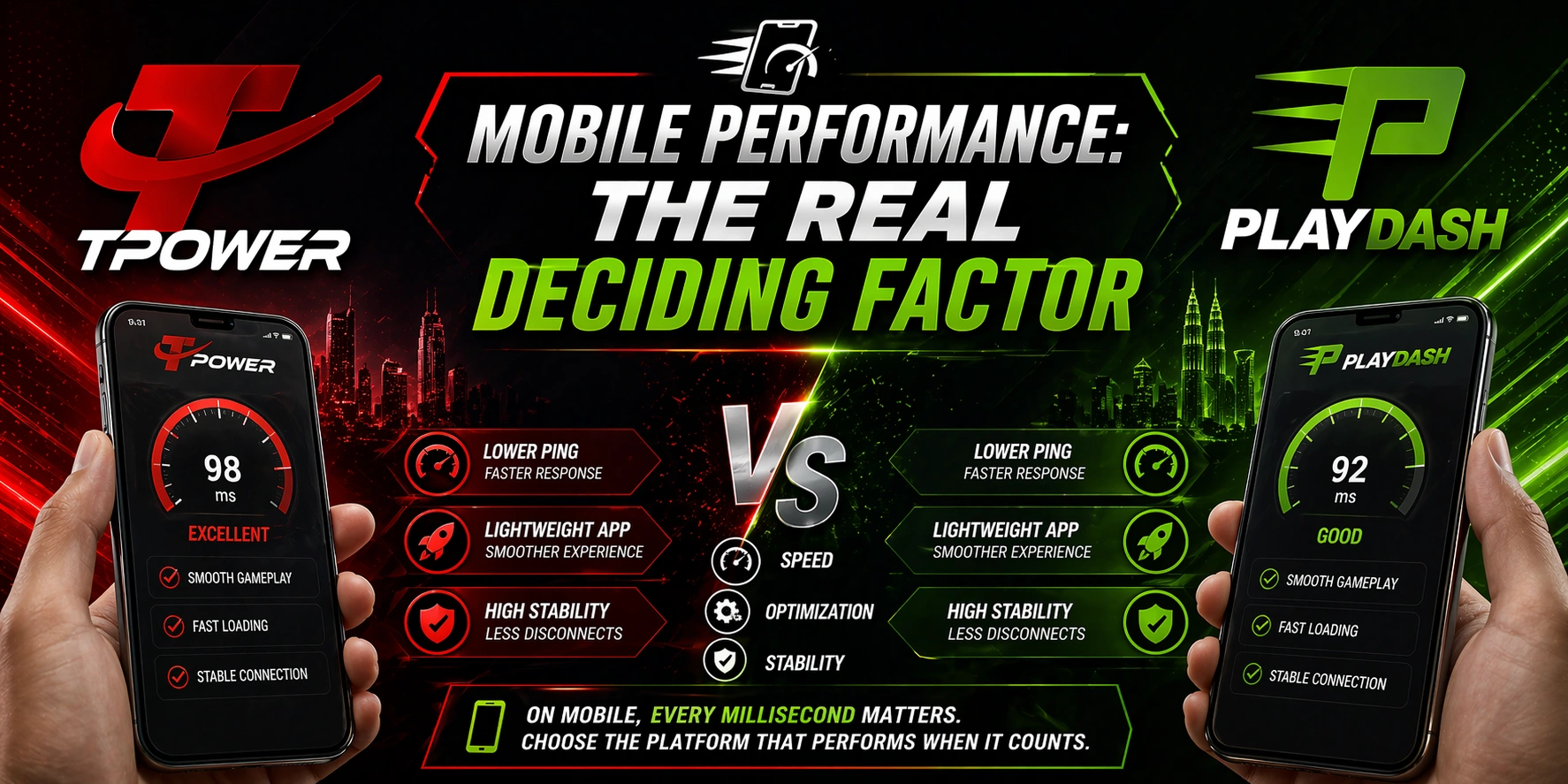
Mobile Performance: The Real Deciding Factor
In Malaysia, mobile usage dominates how users access platforms. Whether on mobile data or WiFi, the ability of a platform to perform smoothly on smartphones plays a major role in overall experience. A system that works well on desktop but struggles on mobile will quickly lose user engagement over time.
To better understand the differences, here is a structured comparison of mobile performance:
| Mobile Factor | Tpower | PlayDash |
|---|---|---|
| Responsiveness | Fully responsive design | Responsive but less refined |
| Loading Speed | Fast on mobile networks | Slightly slower under load |
| Navigation Flow | Smooth transitions | Occasional lag |
| Page Weight | Optimized and lightweight | Heavier page elements |
| Overall Experience | Consistent and fluid | Functional but less stable |
Tpower Mobile Experience
Tpower is designed with mobile performance in mind, ensuring that users can navigate the platform smoothly across different devices and network conditions. Pages load quickly, even when switching between sections, and the overall structure adapts well to various screen sizes.
Users searching for Tpower often prefer it because of its consistent mobile experience. The combination of fast loading speed and responsive design allows users to interact with the platform without delays or interruptions. This is especially important for users who rely on mobile data, where performance consistency can vary depending on signal strength.
PlayDash Mobile Experience
PlayDash is also accessible on mobile devices and provides the necessary functionality for users to navigate the platform. However, compared to Tpower, the experience can feel slightly heavier.
During testing, some delays were observed when switching between sections, particularly under less stable network conditions. The presence of heavier page elements can contribute to slower loading times, which may affect responsiveness over time.
While both platforms support mobile access, the difference becomes clearer with repeated use. A platform that is optimized for mobile not only loads faster but also maintains smoother interaction across sessions.
Pro Tip: Over time, these factors directly influence usability and retention. Users are more likely to continue using a platform that delivers a consistent and responsive mobile experience without unnecessary delays.
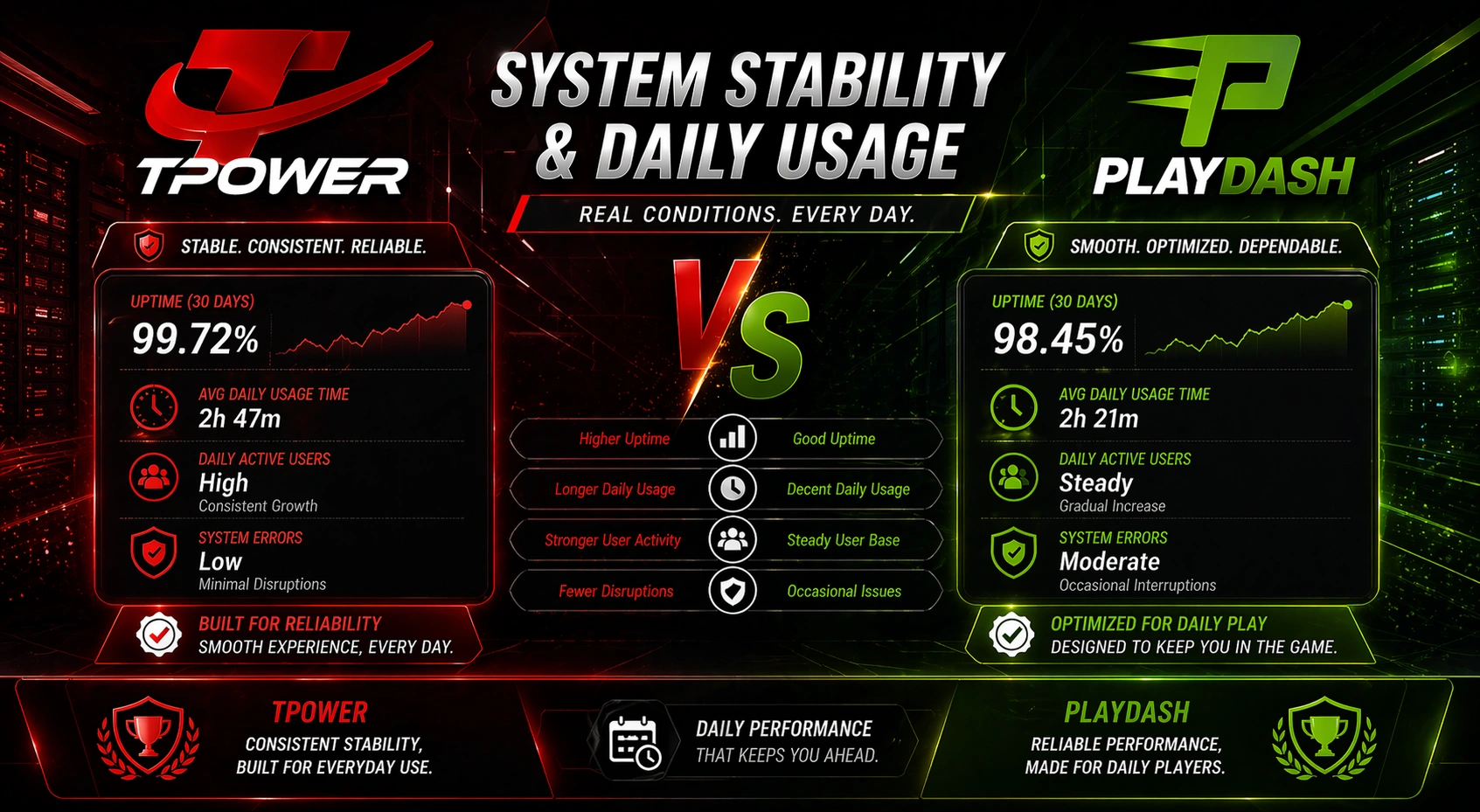
System Stability & Daily Usage
A platform may appear smooth during the first visit, but long-term stability is what truly defines the overall experience. Daily usage involves repeated logins, navigation across multiple sections, and interaction during different times of the day — including peak hours. This is where consistency becomes more important than initial impression.
To better understand how both platforms perform over time, here is a structured comparison:
| Stability Factor | Tpower | PlayDash |
|---|---|---|
| Performance Consistency | Stable across sessions | Varies depending on traffic |
| Downtime Frequency | Minimal | Occasional slow response |
| Peak Hour Performance | Remains steady | Noticeable performance drops |
| Session Reliability | Continuous without interruption | May experience slight delays |
| Overall Experience | Predictable and smooth | Functional but inconsistent |
Tpower Stability
Tpower demonstrates a high level of consistency across different usage conditions. During testing, the platform maintained stable performance regardless of time or network fluctuations. Pages loaded reliably, and transitions between sections remained smooth without unexpected delays.
Another important factor is session reliability. Users were able to stay connected without interruptions, which contributes to a seamless experience. Minimal downtime and consistent responsiveness help create a predictable environment, especially for users who access the platform frequently throughout the day.
This level of stability reduces uncertainty and allows users to interact with the platform without worrying about sudden slowdowns or interruptions.
PlayDash Stability
PlayDash operates well under normal conditions and provides a functional experience for users. However, compared to Tpower, performance tends to vary more depending on traffic and timing.
During non-peak hours, the platform performs adequately with acceptable loading speeds and responsiveness. However, during peak periods, performance drops become more noticeable. Pages may take longer to load, and navigation between sections can feel slightly delayed.
While these issues are not constant, they can affect the overall experience when they occur repeatedly over time.
Stability is not just about whether a platform works — it’s about how consistently it works under different conditions. A system that maintains steady performance builds trust and improves usability, while fluctuations can create uncertainty.
Pro Tip: Over time, stability inconsistency can impact user confidence, making a consistently performing platform the preferred choice for daily usage.
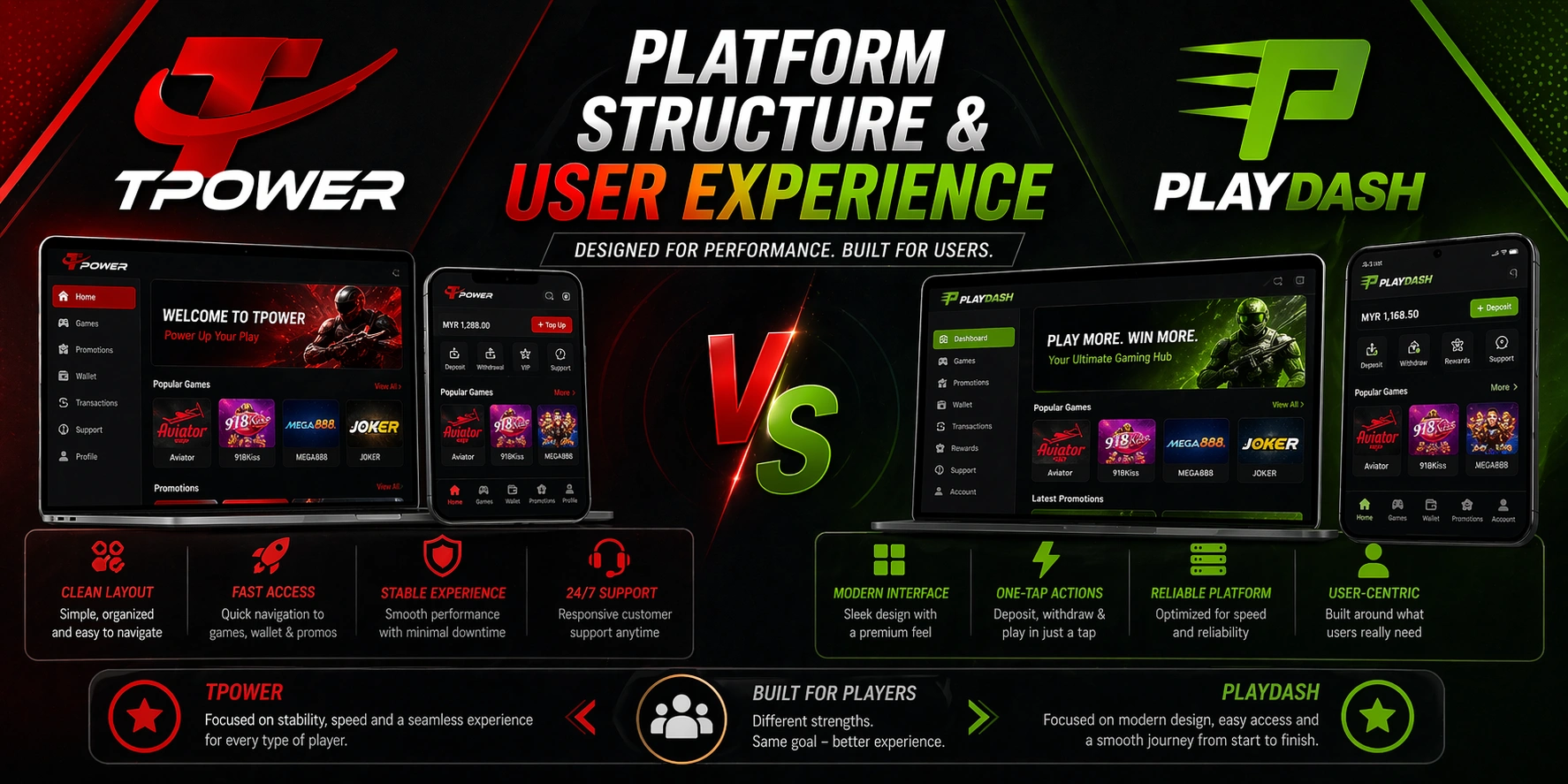
Platform Structure & User Experience
A platform’s structure plays a key role in how users interact with it on a daily basis. While features and performance are important, the way information is organized and presented can significantly impact usability. A well-structured platform allows users to move between sections easily, while a more complex layout can slow down navigation and create unnecessary friction.
To better understand the differences, here is a structured comparison:
| UX Factor | Tpower | PlayDash |
|---|---|---|
| Layout Design | Clean and organized | More layered interface |
| Navigation Flow | Direct and simple | Requires more steps |
| Accessibility | Easy access to key sections | Slightly harder to locate features |
| Learning Curve | Beginner-friendly | Takes time to get used to |
| Overall Experience | Smooth and intuitive | Functional but less streamlined |
Tpower Structure
Tpower focuses on simplicity and clarity. The layout is clean, with clearly defined sections that are easy to identify. Users can access key areas without going through multiple steps, which makes navigation feel faster and more efficient.
This type of structure is especially helpful for new users, as it reduces the time needed to understand how the platform works. Instead of searching through menus or dealing with complex layouts, users can quickly move from one section to another without confusion.
The design prioritizes usability over unnecessary elements, ensuring that the overall experience remains smooth and intuitive.
PlayDash Structure
PlayDash also provides access to similar features, but the structure is slightly more layered. Users may need to go through additional steps to reach certain sections, which can make navigation feel slower, especially for those who are unfamiliar with the platform.
For experienced users, this may not be a major issue. However, for new users, the interface can feel slightly cluttered due to the way information is organized. This can lead to longer navigation time and a less efficient experience overall.
While both platforms offer similar functionality, the difference lies in how that functionality is delivered. A clean and direct structure improves usability, while a more complex layout can introduce small delays in interaction.
Pro Tip: In the long run, the difference is not in design itself, but in execution — how effectively the platform allows users to navigate without friction.
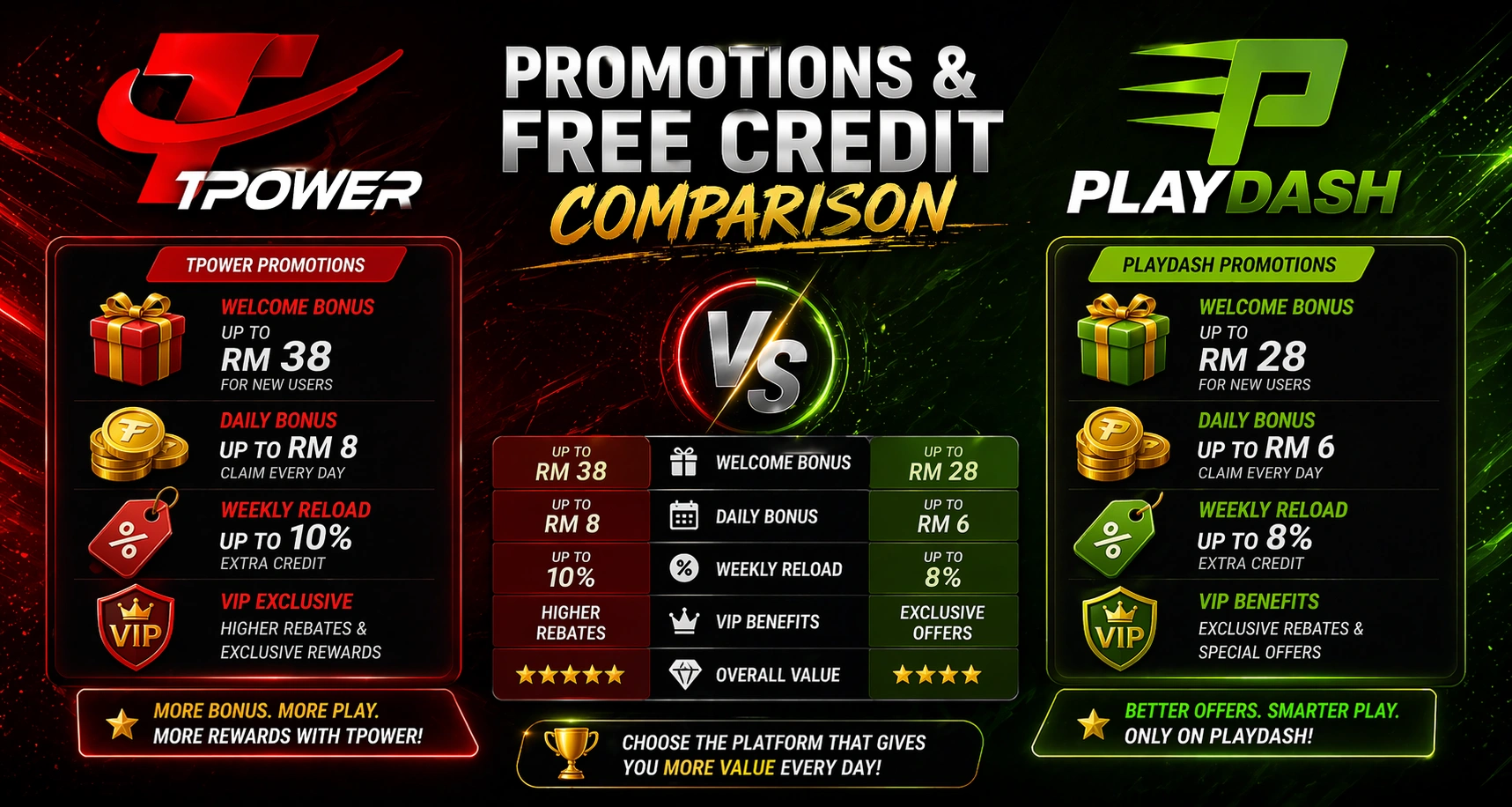
Promotions & Free Credit Comparison
Promotions are often one of the first things users notice when exploring a platform. While attractive offers can draw attention, the real deciding factor is how clear and understandable those promotions are. A large bonus may seem appealing at first, but if the conditions are complicated, it can reduce the overall value from a user’s perspective.
To better compare both platforms, here is a structured overview:
| Promotion Factor | Tpower | PlayDash |
|---|---|---|
| Clarity | Clear and well-structured | Slightly complex |
| Terms & Conditions | Easy to understand | Requires more reading |
| Reward Transparency | Transparent system | Less straightforward |
| Accessibility | Easy to claim and follow | May require extra steps |
| Overall Experience | Simple and user-friendly | Functional but less intuitive |
Tpower Promotions
Tpower focuses on clarity and simplicity when it comes to promotional offers. The structure is designed to help users quickly understand what is being offered and how to access it. Instead of presenting overly complicated conditions, the platform keeps the requirements straightforward.
Users searching for Tpower free credit often benefit from this approach, as the terms are easier to follow and do not require extensive interpretation. This reduces confusion and allows users to make informed decisions without spending too much time reviewing details.
Because the system is transparent, users can clearly see what they are eligible for and how to proceed, which contributes to a smoother overall experience.
PlayDash Promotions
PlayDash also offers competitive promotions that may appear attractive at first glance. However, the structure can be slightly more complex compared to Tpower.
In some cases, users may need to spend more time reviewing the terms and conditions to fully understand how the promotions work. Additional steps or requirements may also be involved, which can make the process feel less straightforward.
While both platforms provide promotional offers, the difference lies in usability. A simpler and clearer structure allows users to engage with promotions more confidently, while more complex conditions can create hesitation.
Pro Tip: In real-world usage, simplicity often leads to a better experience, as users prefer promotions that are easy to understand and quick to access without unnecessary complications.
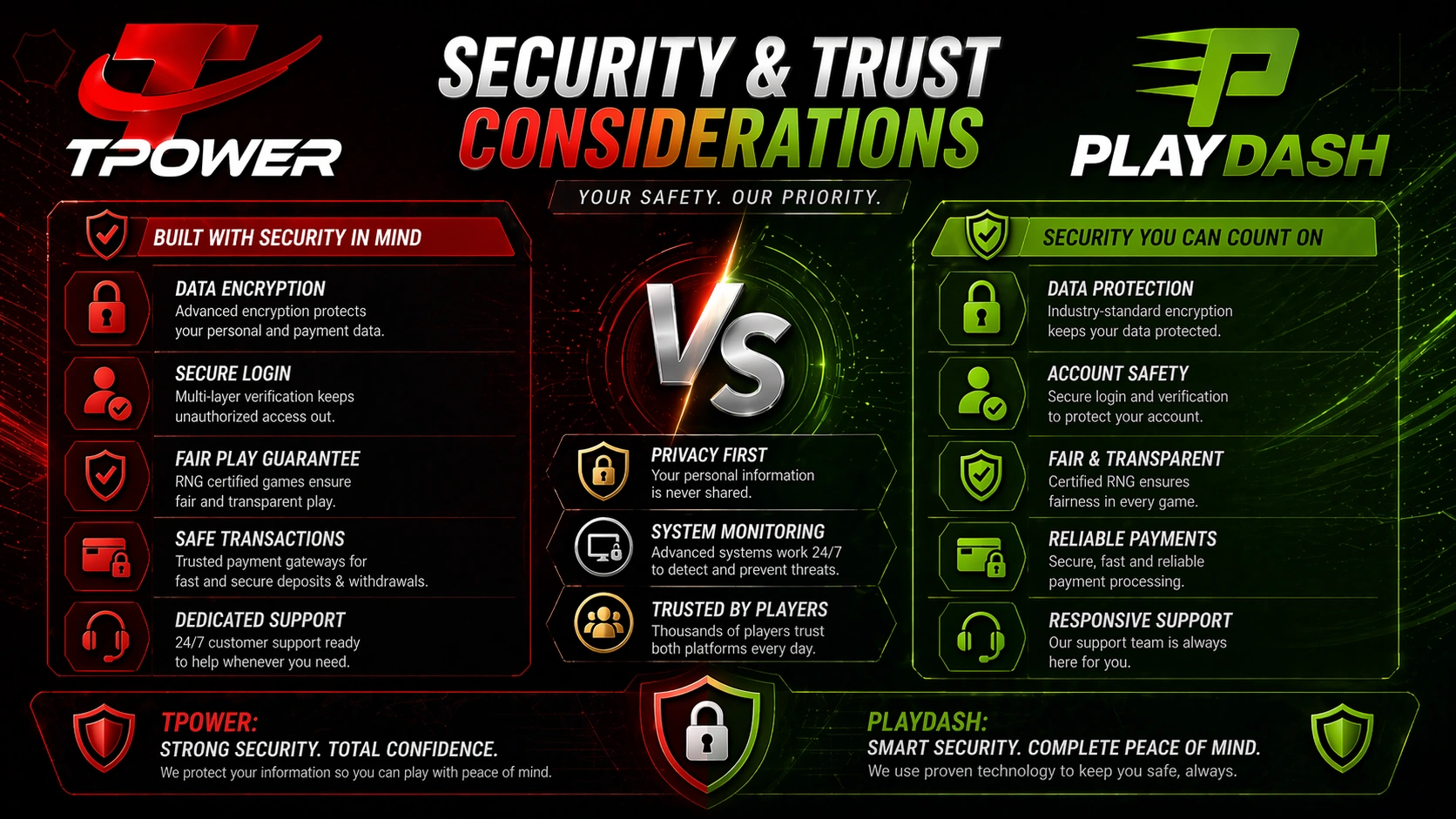
Security & Trust Considerations
Security is one of the key factors users consider before using any platform. While performance and usability are important, users also want to know that their access and information are protected. Most modern platforms implement basic security measures, but the real difference lies in how consistently those measures are maintained during actual usage.
To provide a clearer view, here is a structured comparison of security-related aspects:
| Security Factor | Tpower | PlayDash |
|---|---|---|
| Encryption | HTTPS enabled | HTTPS enabled |
| Account Protection | Standard safeguards in place | Standard safeguards in place |
| Login Security | Stable and consistent | Functional but may vary |
| Session Handling | Reliable and controlled | Occasionally inconsistent |
| Overall Trust Experience | Stable and predictable | Acceptable but less consistent |
Both platforms apply standard security practices such as HTTPS encryption, which helps protect data during transmission. Basic account protection measures are also present, ensuring that user access is handled in a controlled environment. Secure login handling is another shared feature, allowing users to authenticate their accounts safely.
However, security alone does not fully define trust. A platform may have the necessary technical protections in place, but if performance is inconsistent — such as login interruptions or unstable sessions — it can affect how users perceive overall reliability.
Tpower Security Experience
Tpower combines standard security measures with consistent system behavior. During testing, login sessions remained stable, and there were no unexpected interruptions. This consistency helps reinforce trust, as users can access their accounts without concerns about sudden disconnections or irregular system responses.
PlayDash Security Experience
PlayDash also implements the necessary security measures and provides a generally safe environment for users. However, the experience may vary slightly depending on conditions. Occasional inconsistencies in session handling or performance can affect how secure the platform feels, even if the underlying protections are in place.
Trust is built not only through security features but also through consistent delivery of those features over time. A platform that maintains stable performance alongside proper security practices will naturally create a stronger sense of reliability.
Pro Tip: If you want a deeper understanding, you can refer to this detailed analysis: Is Tpower Legit or Scam in Malaysia?
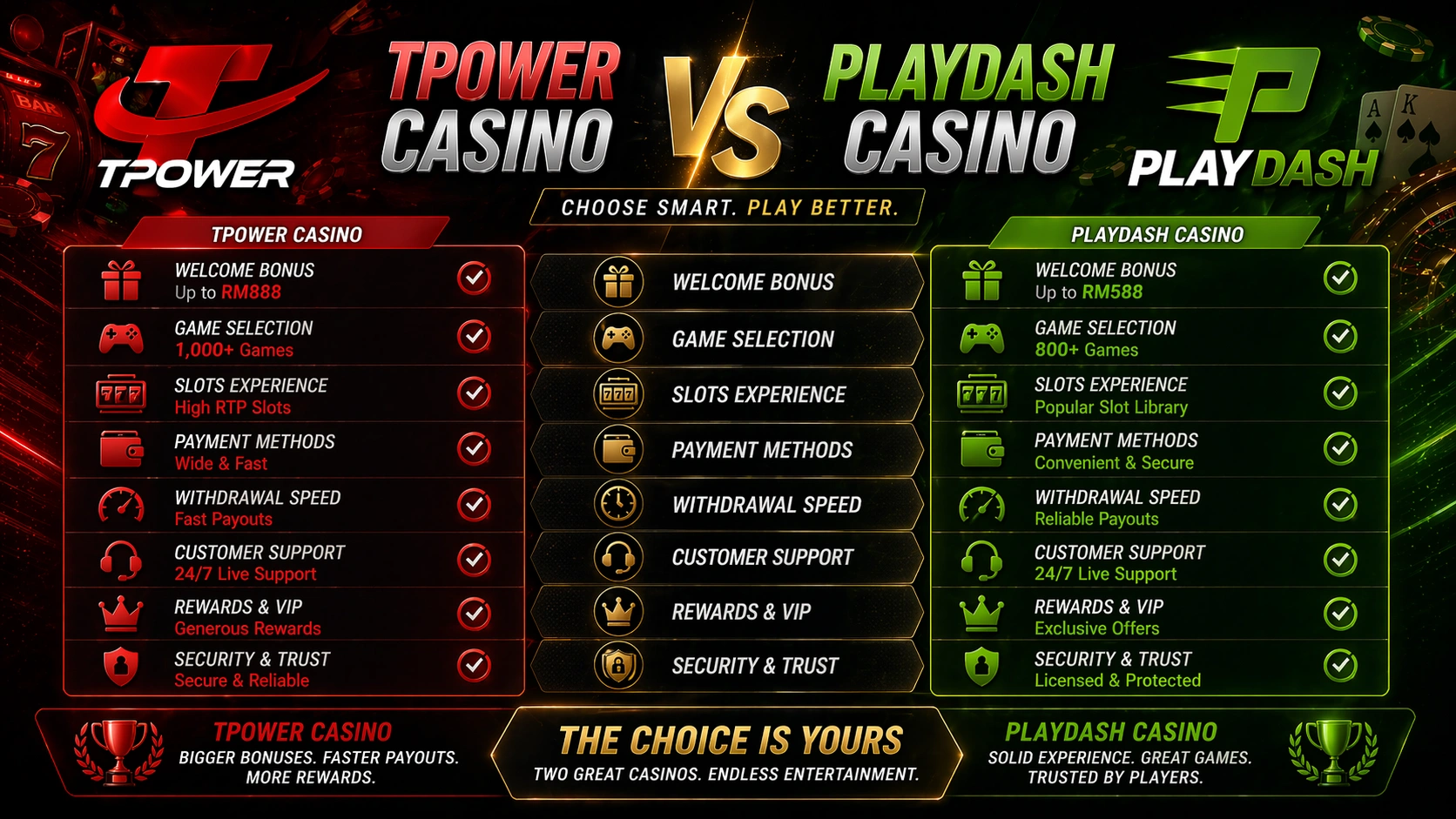
Tpower Casino vs PlayDash Casino
When comparing Tpower Casino and PlayDash casino, the differences become more noticeable during actual gameplay sessions rather than at first glance. Both platforms provide access to similar types of games, but the way users interact with those games can vary depending on speed, stability, and overall system flow.
To better illustrate the differences, here is a structured comparison:
| Feature | Tpower Casino | PlayDash Casino |
|---|---|---|
| Game Access | Direct and fast | Slight delay before entry |
| Loading Speed | Consistent across sessions | Varies depending on traffic |
| User Flow | Smooth and uninterrupted | Slightly interrupted at times |
| Overall Experience | Stable and predictable | Less consistent |
Tpower Casino Experience
Tpower casino focuses on delivering a smooth and responsive experience from the moment users enter a game. Access is direct, allowing users to move from the main interface into gameplay without unnecessary waiting time. This creates a seamless transition that feels natural, especially for users who frequently switch between different games.
Loading speed remains consistent even after extended use, which helps maintain a steady flow during gameplay. Combined with stable system performance, this results in an experience that feels reliable and easy to navigate. Users can interact with different sections without noticeable interruptions, making the platform suitable for both short and longer sessions.
PlayDash Casino Experience
PlayDash casino also offers access to a variety of games, and under normal conditions, it performs adequately. However, compared to Tpower, the experience can feel slightly less fluid.
During testing, minor delays were observed when entering certain games, particularly during peak hours. While these delays are not constant, they can interrupt the overall flow, especially for users who expect immediate access. Loading speed may also vary depending on traffic, which can affect consistency across sessions.
While both platforms provide functional gaming environments, the key difference lies in execution. A system that allows direct access, maintains stable loading speeds, and supports smooth transitions will naturally offer a better user experience.
Pro Tip: Over time, consistency in game access and performance plays a major role in overall satisfaction, making stability an important factor when choosing between platforms.
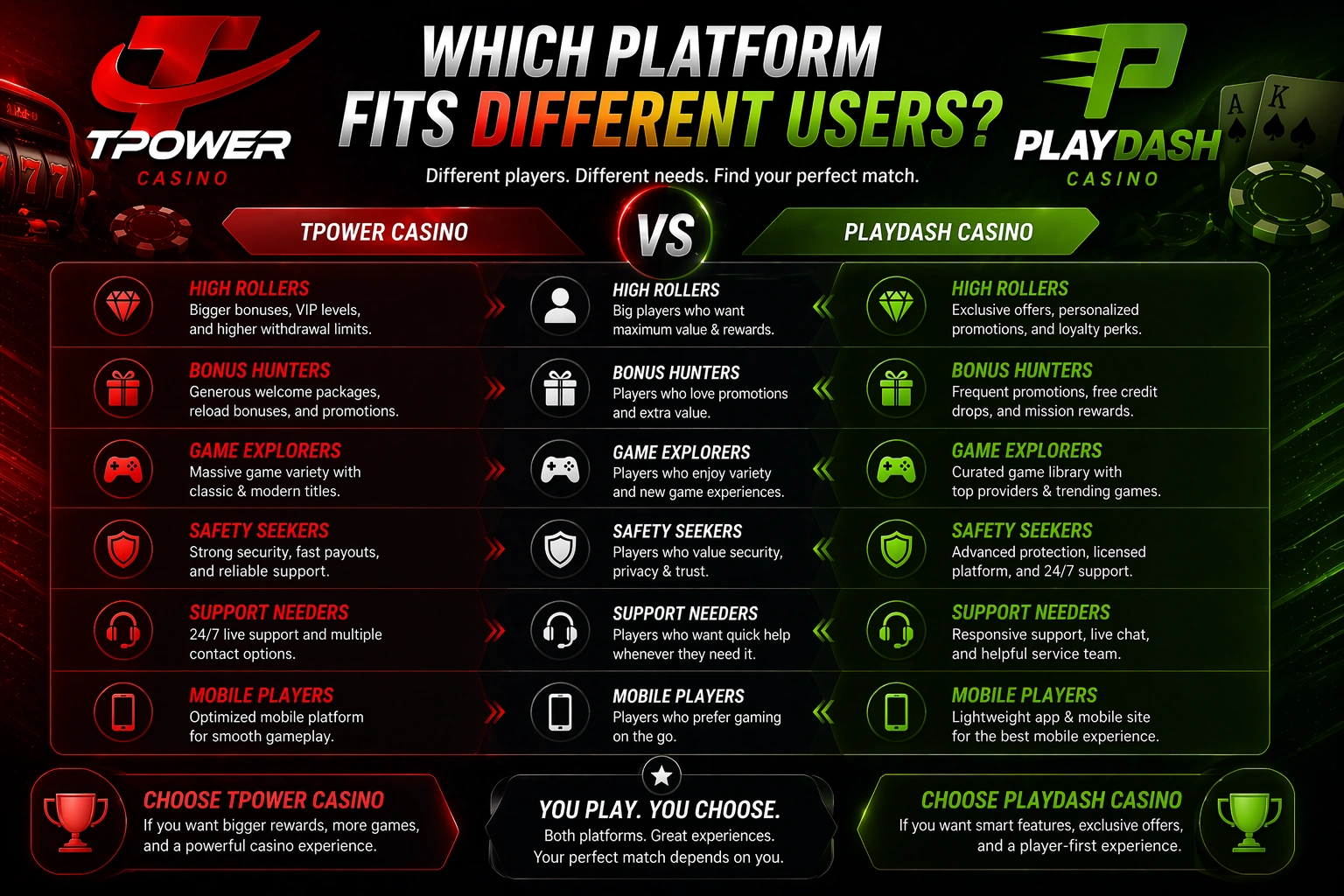
Which Platform Fits Different Users?
Not every platform suits every user, as preferences can vary depending on individual priorities and usage habits. Some users focus on speed and efficiency, while others may value familiarity or are willing to accept minor delays in exchange for specific features. Understanding how each platform fits different user types can help provide a clearer direction when making a choice.
To simplify the comparison, here is a structured overview:
| User Type | Tpower | PlayDash |
|---|---|---|
| New Users | Easier to use, simple navigation | Slight learning curve |
| Mobile Users | Better optimized for mobile devices | Moderate performance |
| Frequent Users | Stable and consistent | Less predictable over time |
| Speed-Focused Users | Faster access and response | Slower in comparison |
Tpower for Different Users
Tpower is generally more suitable for users who prefer a straightforward and efficient experience. New users can get started quickly due to its simple structure and easy navigation, reducing the need to spend time learning how the platform works.
For mobile users, Tpower provides a more optimized experience, allowing smooth interaction across different devices and network conditions. This is particularly important in Malaysia, where mobile usage is the primary method of access.
Frequent users may also benefit from the platform’s consistency. Stable performance across multiple sessions helps create a predictable environment, which is important for users who access the platform regularly. Additionally, users who prioritize speed will find Tpower more aligned with their expectations, as it delivers faster loading times and smoother transitions.
PlayDash for Different Users
PlayDash remains a functional option and may appeal to users who are already familiar with its structure. While new users may need some time to get used to the interface, experienced users can navigate it more comfortably over time.
For mobile users, the platform performs adequately, although it may not feel as optimized as Tpower. Frequent users may notice variations in performance, especially during peak hours, which can affect consistency.
Choosing the right platform depends on what matters most to the user. While both platforms provide similar functionality, differences in speed, stability, and usability can influence the overall experience.
Pro Tip: In most cases, users who value simplicity, consistency, and faster access may find one platform more suitable than the other.
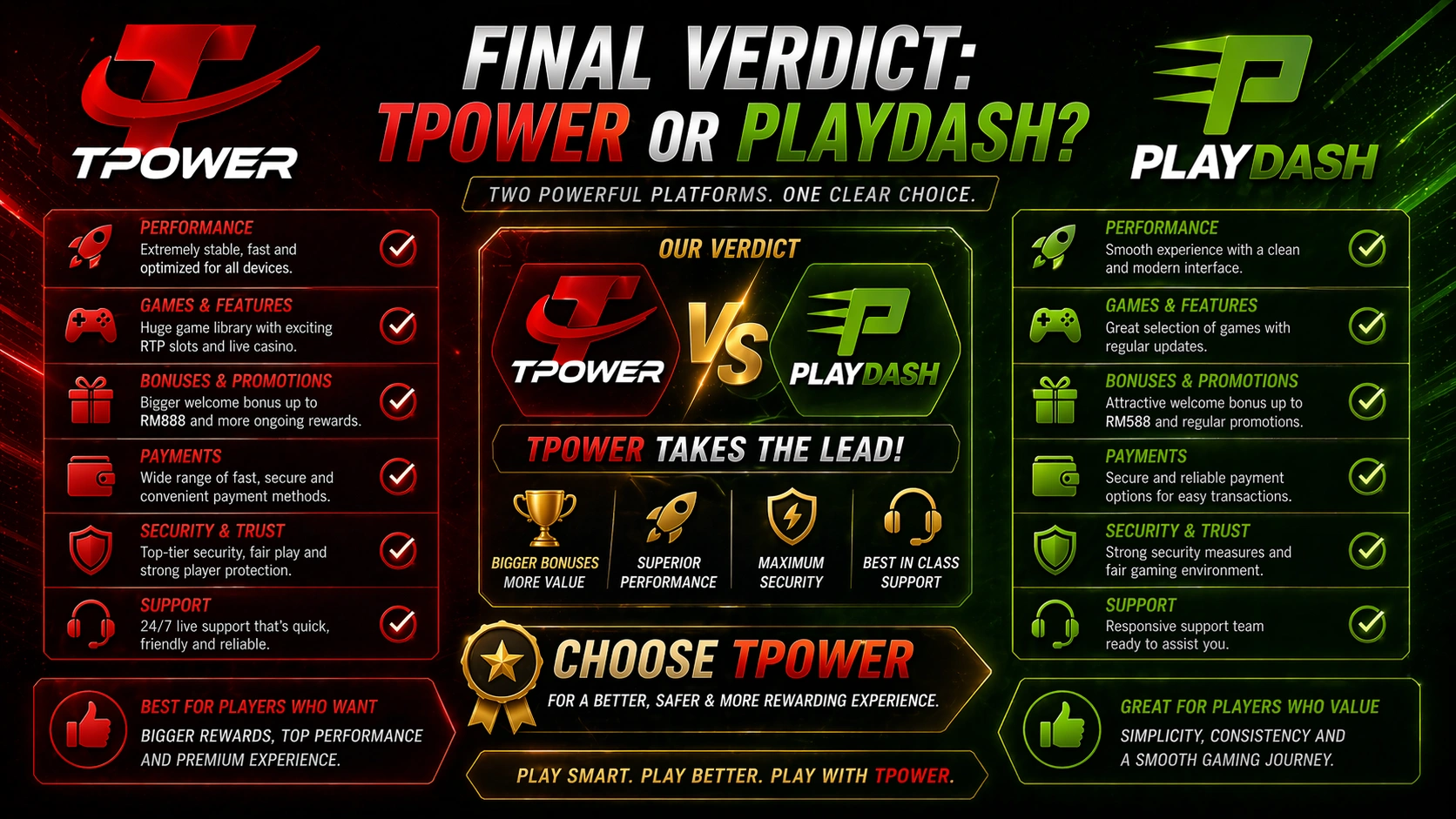
Final Verdict: Tpower or PlayDash?
TL;DR: Tpower delivers a faster, more stable, and more consistent experience, while PlayDash remains functional but may show slight performance variations over time.
After comparing both platforms under real usage conditions in Malaysia, the differences become more noticeable through daily interaction rather than initial appearance. While both platforms provide access to similar features, the overall experience is shaped by how consistently those features perform over time.
Tpower places a strong emphasis on speed, stability, and simplicity. These elements work together to create an environment where users can move between sections smoothly, access their accounts without delays, and maintain a steady experience across different sessions. The structure feels more refined, especially for users who prefer a straightforward and efficient workflow.
PlayDash, on the other hand, remains a functional platform that supports standard usage. It is capable of delivering the expected features, but the experience may vary depending on timing and network conditions. During extended use, small inconsistencies — such as slower loading or occasional delays — can become more noticeable.
Ultimately, the decision depends on what matters most to the user. For those who prioritize a smoother, more predictable experience with minimal interruptions, one platform naturally aligns better with those expectations.
Over time, consistency and ease of access tend to play a bigger role in overall satisfaction than feature availability alone.
Final Insight: In real-world usage, platforms that maintain stable performance and faster access will naturally deliver a better long-term experience for users in Malaysia.